Longing and Belonging
The Art of Being Human, January response


This year, the visual artist Jane Shore and writer/filmmaker Sam Chaltain are co-hosting a collaborative project in which, each month, a different one-word prompt will invite us all to construct an offering -- a piece of writing, a visual collage, music, video, or whatever suits your purpose -- that will help the rest of us understand how you interpret the significance of that word, and its relationship to our ongoing survival as a species.
For January, that word is belonging.
This is Sam’s response.
Share yours here.
And subscribe to The Art of Being Human to receive regular updates about the project.
Like you, perhaps, I have always been searching for my proper place.
At times, I lost my way.
At others, I found the people who gave me ballast, or restored my faith in love.
But beyond the particulars of my single story, I believe our essence as humans can be conveyed in just three words:
Longing and belonging.
“The word ‘belonging’ holds together the two fundamental aspects of life,“ writes John O’Donohue in Eternal Echoes. “We long to belong because we feel the lonesomeness of being individuals. Deep within us, we long to come in from separation and be at home again in the embrace of a larger belonging.”
I always read that line to mean our need for a larger sense of belonging with one another. But I’m beginning 2026 with a different interpretation, and a different sort of prayer.
It was shaped by a book I read over the holidays, Robert Macfarlane’s Is a River Alive? It’s a beautiful, globe-trotting account of three water bodies: a cloud forest in Ecuador; a cluster of poisoned waterways in India; and a holy river in Canada. And it’s a meditation on the ways we humans have lost our way -- and how we might find our collective way home by remembering the inherent aliveness of land and water -- a ‘grammar of animacy,’ as Robin Wall Kimmerer put it.
Macfarlane’s stories offer three ways to reclaim our awareness of that polyphonic world -- and realize the extent to which just about every non-human member of that world has been denied voice for far too long.
In Ecuador, for example, we learn of the country’s radical decision in 2008 to become the first nation in the world to enshrine the rights of nature into its constitution. (!!!)
Nature, or Pacha Mama, where life is reproduced and occurs, has the right to integral respect for its existence and for the maintenance and regeneration of its life cycles, structure, functions and evolutionary processes.
This effort wasn’t merely symbolic; it stopped in its tracks an impending plan to carve up the forest for economic gain. And Ecuador’s bravery has since spawned a global Rights of Nature movement, one that’s helping more countries legally recognize “that our ecosystems – including trees, oceans, animals, and mountains – have rights just as human beings have rights. Rights of Nature is about balancing what is good for human beings against what is good for other species. It is the holistic recognition that all life, all ecosystems on our planet are deeply intertwined.”
I have always known this to be true. We all have.
But we have catastrophically lost sight of it.
We have ceased to feel the truth of it in our daily lives.
And now, as Barry Lopez puts it, we are left searching for the boats we forgot to build.
So as I begin 2026 with this one-word prompt, it makes me realize I want to widen the circle of my own belonging.
What will that mean for me personally? I’m not sure yet.
More time walking in the woods next to my home.
More active support for the Rights of Nature movement.
Feeling the current -- and finding the flow -- of aliveness that surrounds me.
And noticing the eternal longing that makes us all human.
“Exalted we are,” EO Wilson once wrote, “risen to be the mind of the biosphere without a doubt, our spirits uniquely capable of awe and ever more breathtaking leaps of imagination. But we are still part of Earth’s fauna and flora, bound to it by emotion, physiology, and, not least, deep history. Until we allow some of Nature’s stillness to reclaim us, we will remain victims of the instant and never enter the heritage of our ancient belonging.”
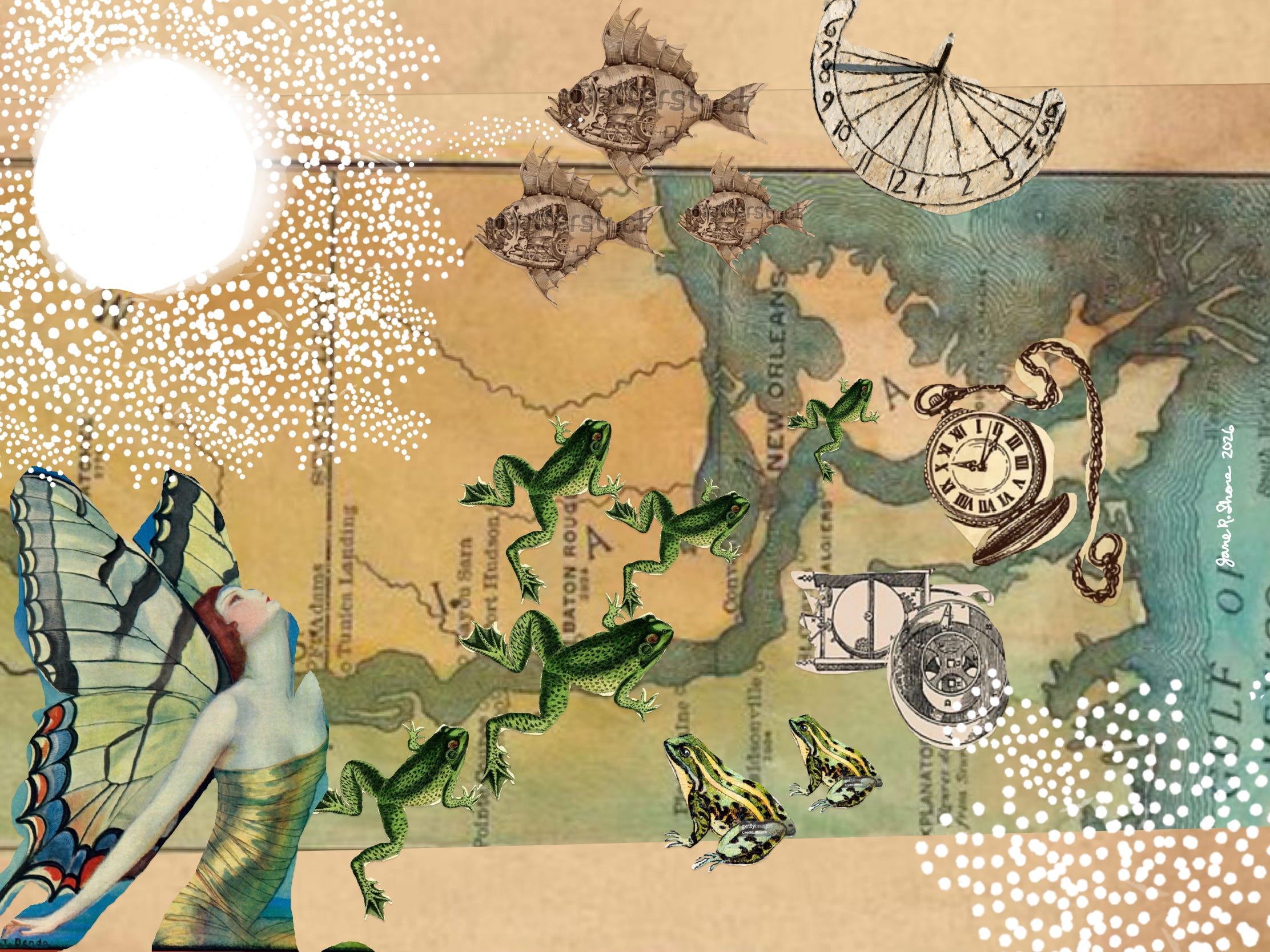
Sam’s reflection on rivers as living, relational beings made me think about place as something that holds us, not all at once, but over time.
This collage is built on a map of New Orleans, a city shaped by a river that is never still. The figures, creatures, moons, and scattered markers of time are an invitation to wonder how belonging takes form: through movement and memory, ecology and return, through the many ways we measure our lives…by water, by bodies, by stories.